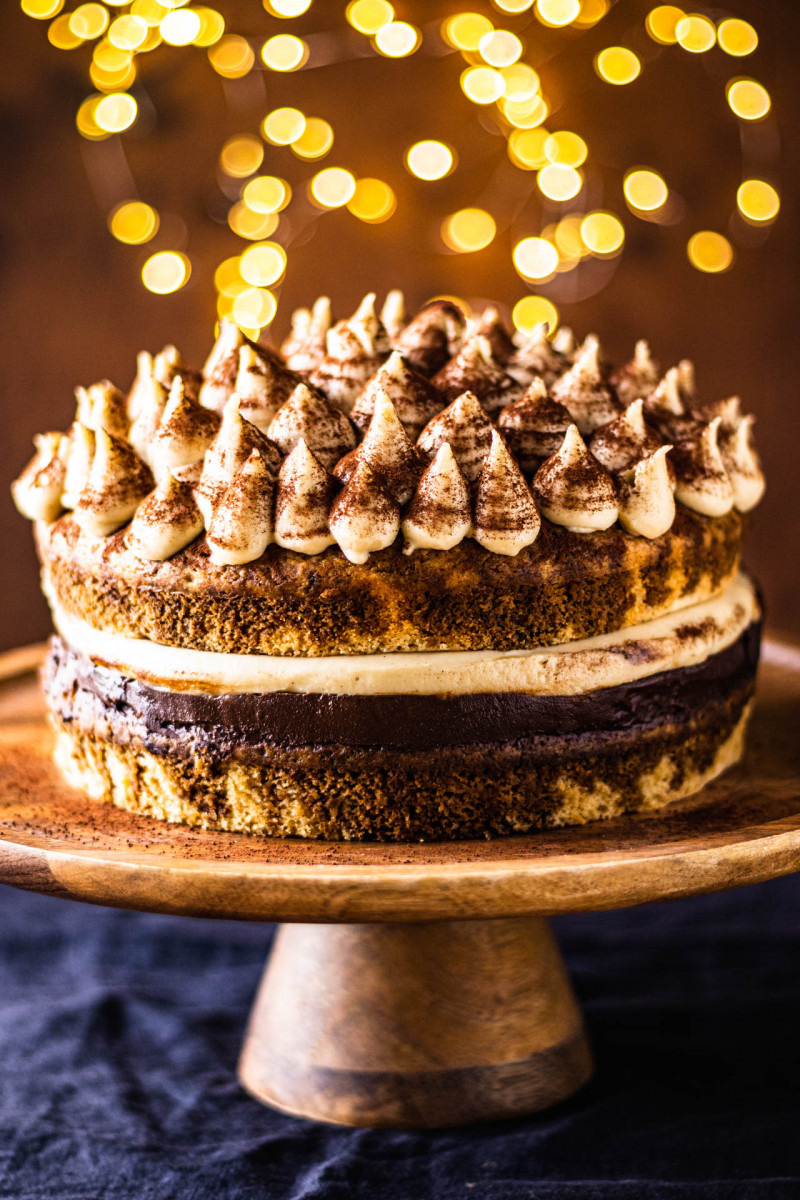
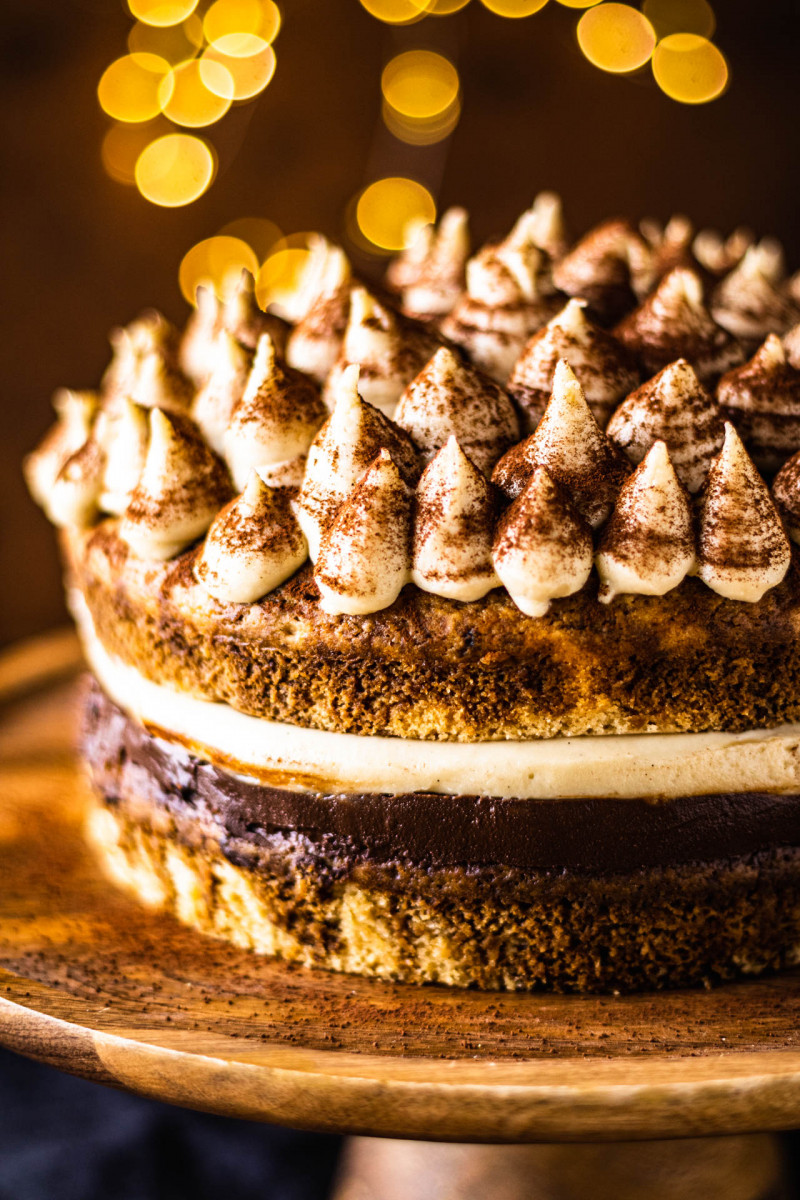
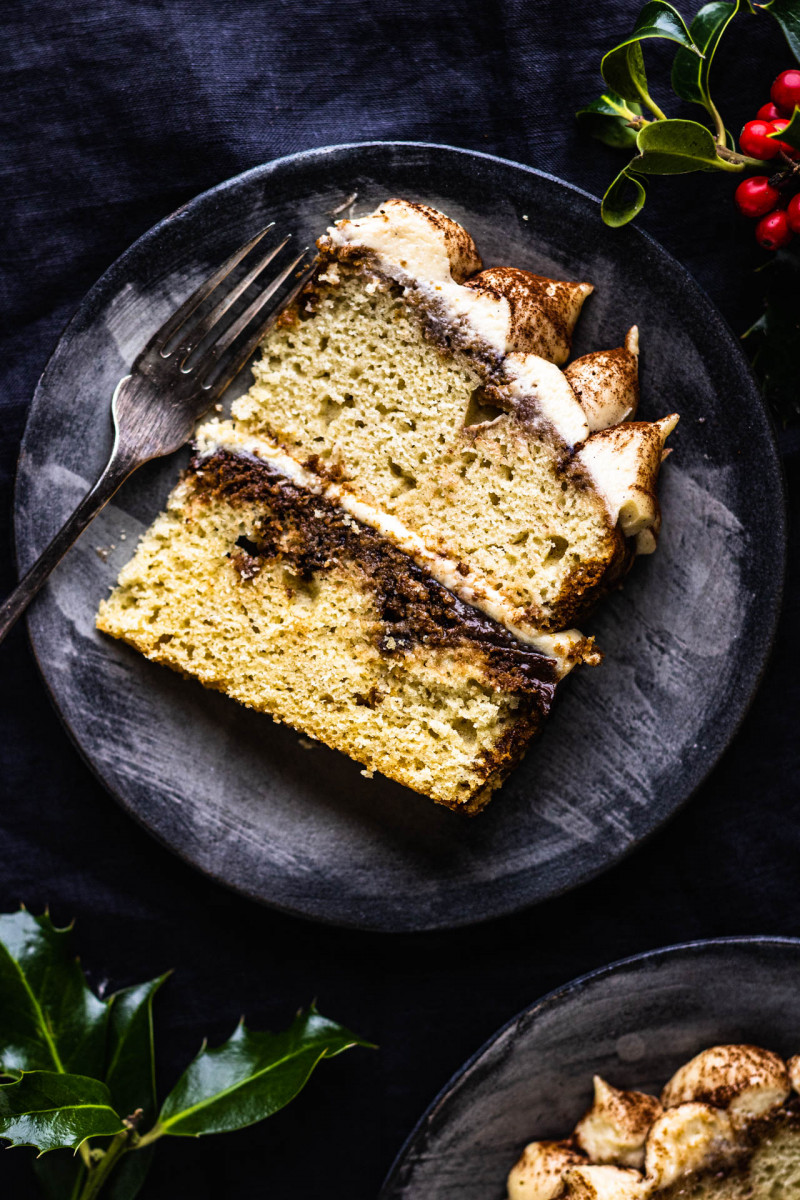
And so it’s Christmas!! On this occasion I made a a vegan tiramisu cake – a bit of a showstopper inspired by my favourite hot beverage! This magnificent two layered cake has it all. Coffee and marsala wine soaked vanilla sponge, a layer of coffee infused chocolate ganache and a silky smooth vanilla mascarpone-like cream for flavour contrast.
This vegan tiramisu cake has simple ingredients and a very simple process, but just like regular tiramisu (my vegan version is here), it is a bit of a labour of love. Mostly due to the fact that you need time to allow things to bake, set and soak so do not attempt this cake if you need something in a hurry. It’s a cake that rewards patience.
To be completely frank with you, I am not 100% happy with how the photos turned out and although the temptation to make it again is huge, I don’t have the time or the energy quite frankly so I am letting myself roll with this imperfection no matter how uncomfortable that feels. I know that perfectionism is a trap! Wishing myself and you more self-compassion this Christmas and in the coming New Year!
MORE ABOUT THE INGREDIENTS
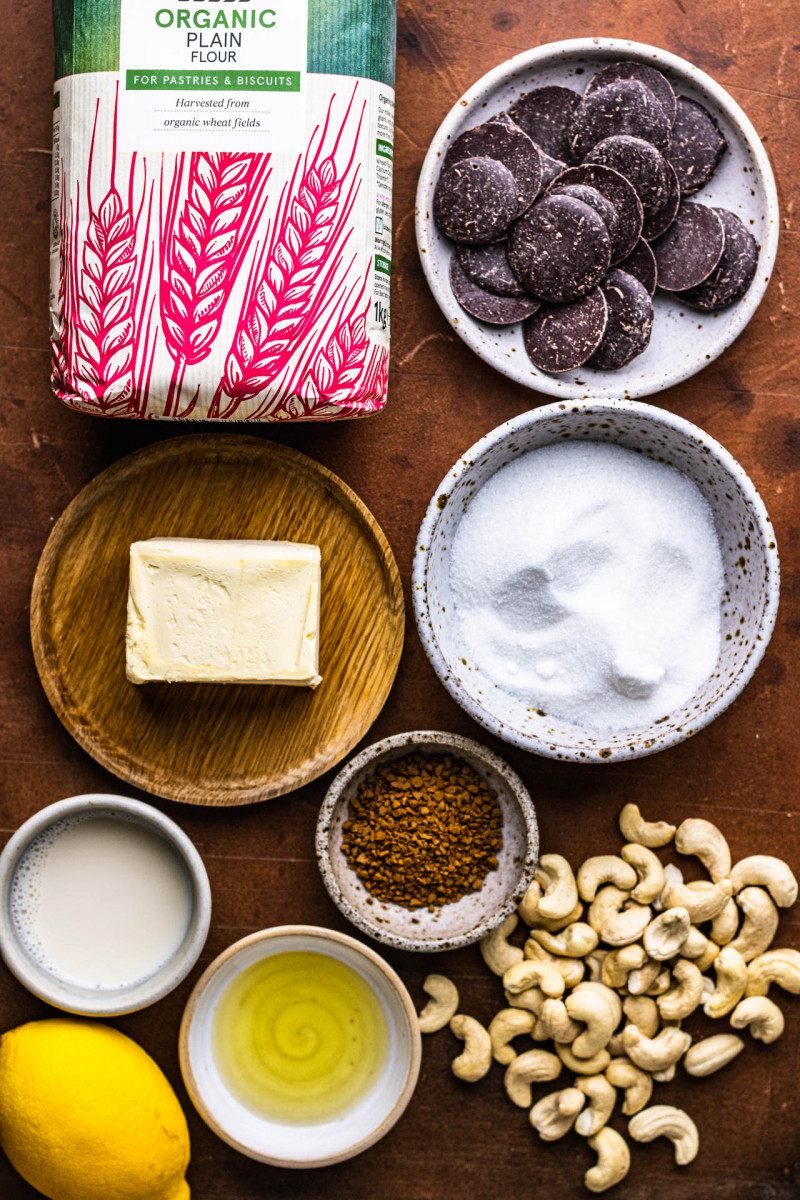
COFFEE: I used decaffeinated instant coffee to make a coffee soak to moisten and flavour my vanilla sponges with. I also added a generous amount of coffee to the chocolate ganache to create and coffee flavoured chocolate layer.
CHOCOLATE: I used 72% dark chocolate to create a simple ganache that sets on top of the first cake layer. When picking a chocolate bar for this cake, make sure to pay the attention to the percentage of cocoa
CASHEWS: I made the cream layer using raw cashews. They have a neutral, slightly sweet, taste and are quite fatty so blend into a delicious cream with ease. To help your blender achieve silky consistency without any texture, soak cashews in water. Ideally overnight, but if you have good blender soaking them in boiling water for 30 minutes (or even boiling them for 10) also works well.
VEGAN BUTTER: Vegan butter is used in the cream layer to stiffen it. You can use any vegan butter you like as long as it’s the solid type, the one that comes in a block (not the spreadable one that is sold in tubs). I used Naturli, which is a Danish brand sold in Sainsbury’s and Waitrose in the UK. It’s unsalted and I would not recommend salted for this application unless you like a sweet-savoury frosting 😉
VANILLA: I used a generous amount of vanilla extract both in the cake and in the frosting. You can skip them if you have to, but the flavour won’t be as good. If you do omit vanilla, compensate by adding extra plant milk in both cases.
BAKING AGENTS: I used both baking soda and baking powder to give these cakes a nice rise.
PLANT MILK: I used soy milk for both the cream and the cakes, but it doesn’t really matter that much, any plant milk will work.
LEMON: Lemon juice is added to the cake batter to help the cake rise. It comes into a reaction with baking soda and creates air bubbles into the cake mixture. You can also add some lemon juice to the cream layer (instead of some of the milk, not in addition to!!) if you like. I didn’t think it was needed, but some people like a bit of a tang in their vegan ‘mascarpone’. If you are ones of them, you are welcome to add lemon juice to your taste.
PLAIN FLOUR: I used plain white flour to make the sponges for this vegan tiramisu cake and that’s the type of flour I recommend. I have not tried making this particular cake without gluten but in my experience, if you use a good blend of gluten-free flours and 3½ tsp of xanthan gum (½ tsp per 1 cup of flour) it will work perfectly.
SUGAR: Caster sugar, which is superfine white sugar is what I used to sweeten the cakes, the cream and the ganache. It’s a staple here in the UK and I hope you can find an equivalent where you live. Because it’s a sugar that has very small particles it dissolves quickly and evenly in baking. For the cream, it is important to use white sugar as otherwise the colour of the cream will be affected.
NEUTRAL OIL: Neutral flavoured oil, like grapeseed, peanut or mild olive oil is what I like to use to make cakes as it produces soft and moist cakes.
HOW TO MAKE IT?
1) A DAY AHEAD – MAKE THE CREAM
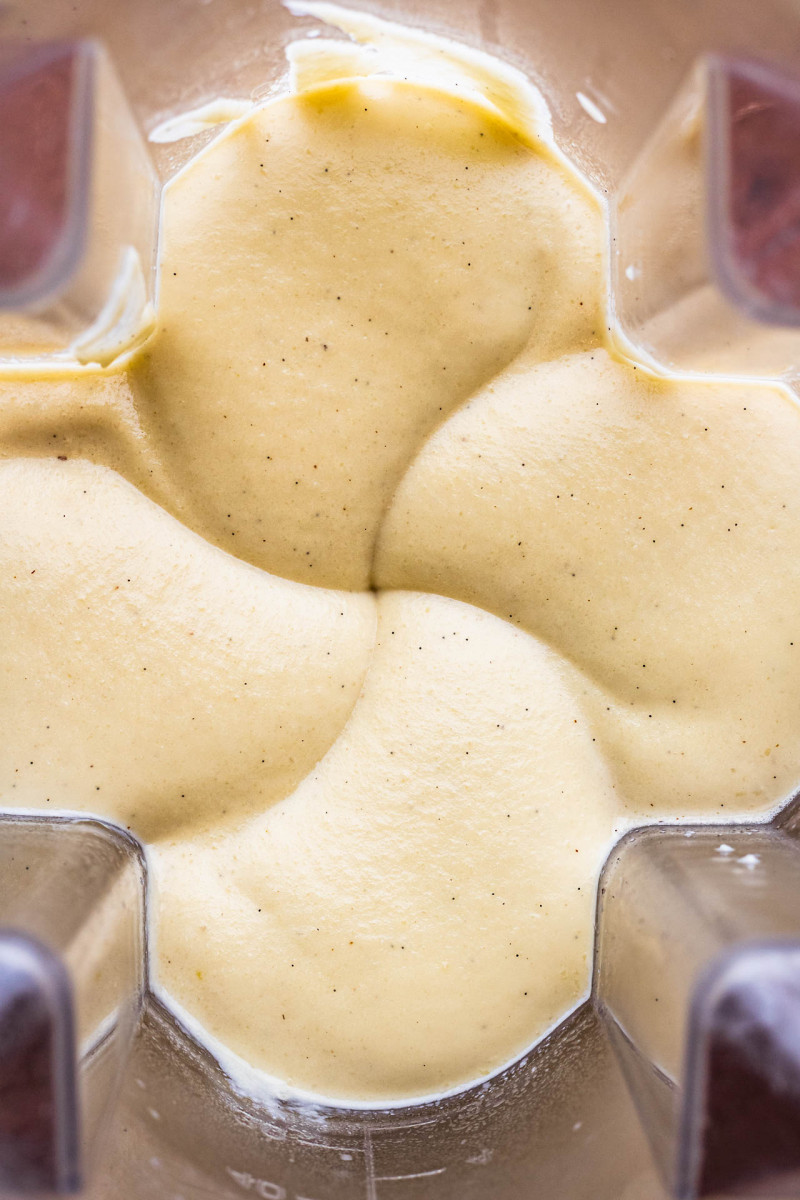
You need to make the cream a day ahead of assembling the cake as it needs enough time in the fridge to firm up. The first thing to do is to soak the cashews (simply cover them) with cold water if you can soak them for several hours (or overnight) or in boiling water for 30 minutes. I prefer to soak them for longer to make sure the cream is silky smooth but my blender is powerful enough that even a 30 minutes soak in boiling water is enough, if your blender isn’t as good you may want to soak them for longer. Once the cashews are soaked, drain them and add to the blender with vanilla extract. In a pot combine sugar, plant milk and vegan butter. Warm up on low heat just until the butter is fully melted. Stir well and add to the blender. Blend until the mixture is super smooth with no pieces of cashews visible at all. Transfer to a container and refrigerate to firm up.
2) BAKE THE CAKE
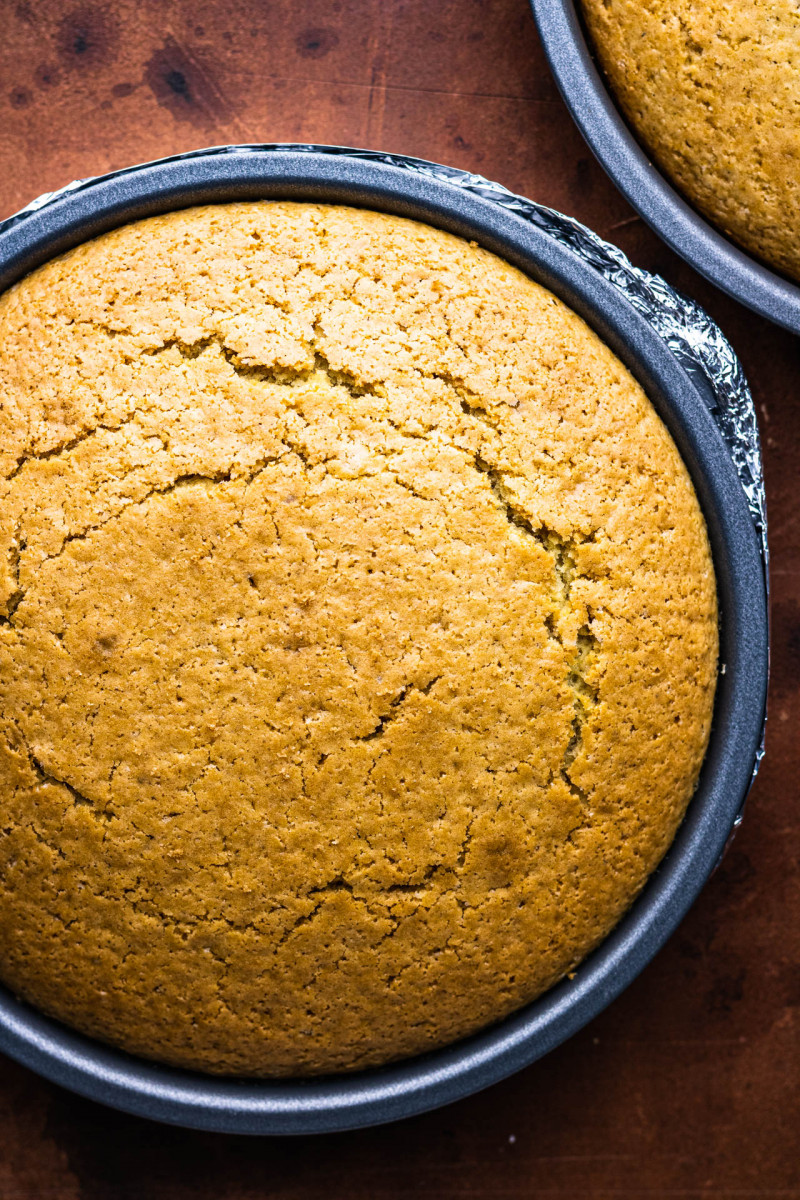
Prepare the cake batter in divide it evenly between two 20 cm / 8″ pans. You may want to wrap baking strips around the tins so that the cakes do not dome as much. I used an old kitchen towel, which I cut in half, soaked in cold water, wrung out and carefully wrapped in kitchen foil around one of the cakes and baked the cake at a lower temperature (160° C / 320° F without a fan) and it did result in a more evenly baked cake that did not dome as much.
3) SOAK THE CAKE
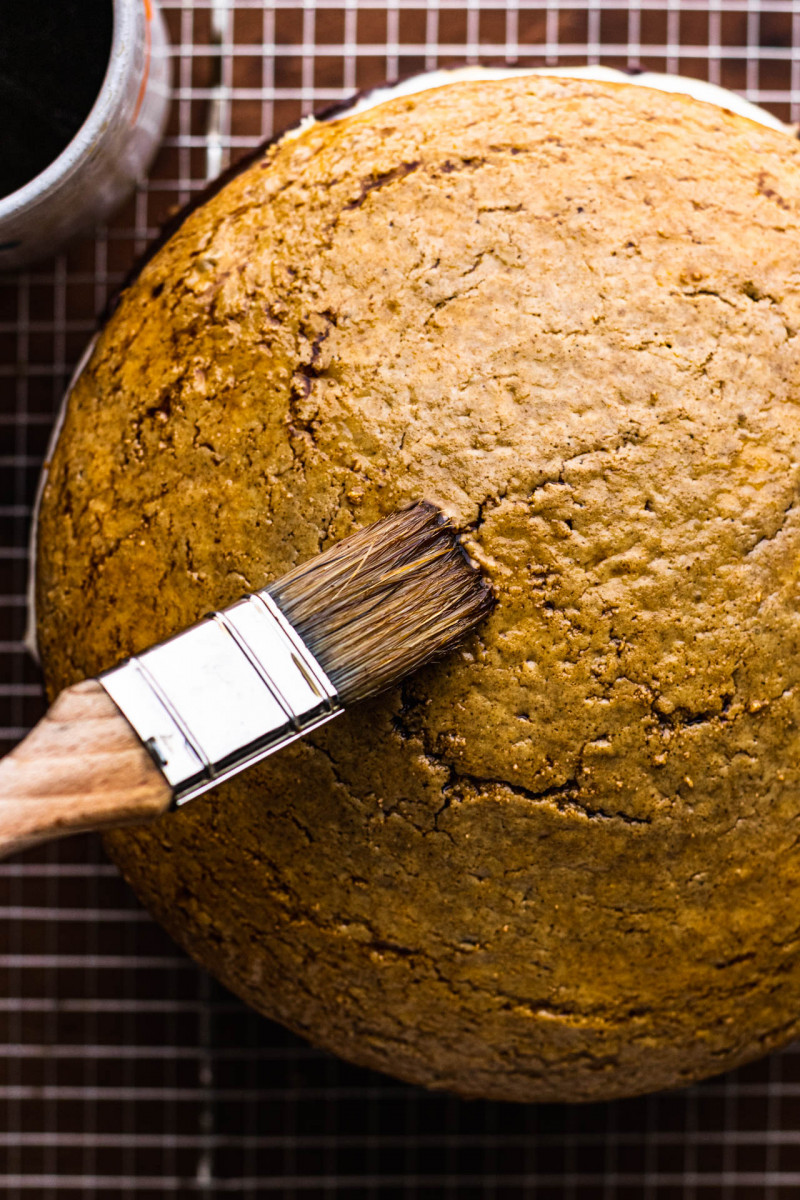
Once the cakes are cold, brush half of the coffee soak over the cake’s surface. In order for then coffee to soak in, I recommend cutting the ‘skin’ off the cake’s surface (I didn’t do that and I wish I had) with a serrated knife or poking lots of little holes with a toothpick.
4) MAKE THE GANACHE & LET IT SET
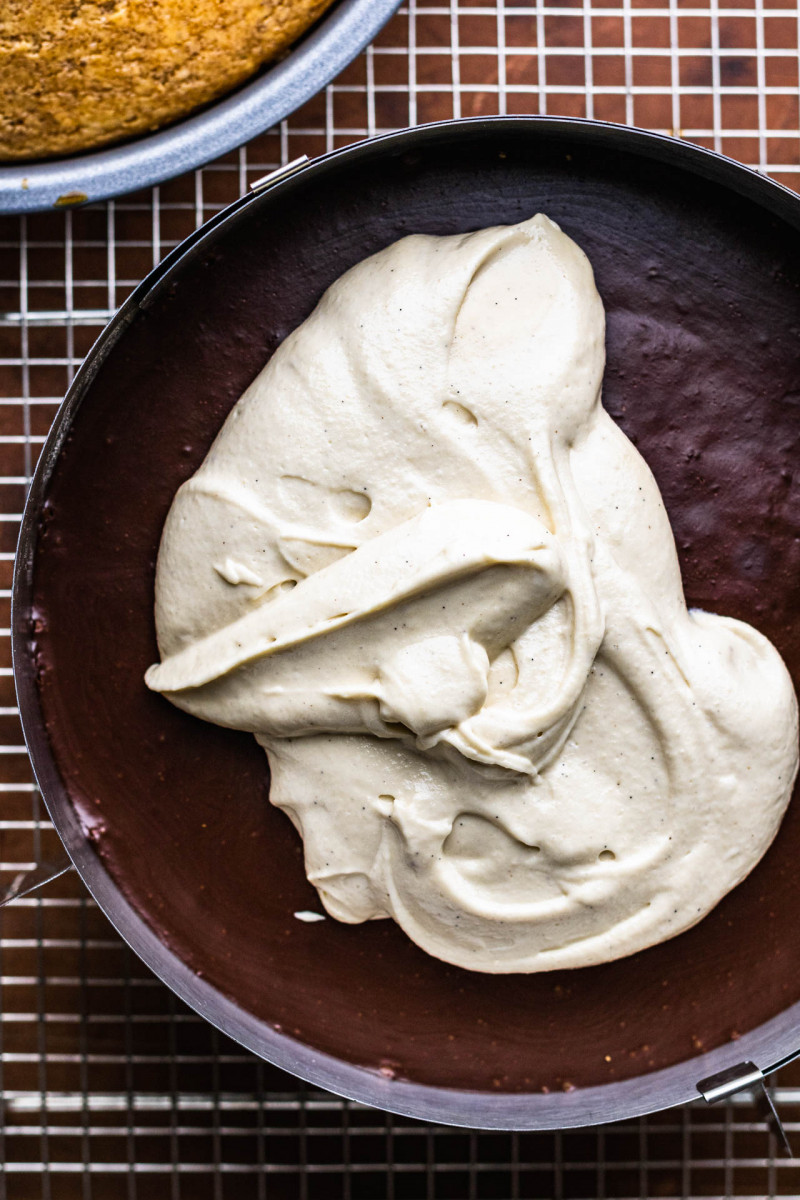
Combine broken up chocolate and Oatly cream in a metal or glass bowl suspended over a pot of water, but make sure the bottom of the bowl does not touch the water. Set on low heat and allow the chocolate to melt slowly into the cream – do not stir yet. Once the chocolate has melted, switch off the heat and stir the two together gently. Then slowly in add instant coffee dissolved in hot water. Stir gently together. Allow the ganache to cool down, but not solidify before pouring over the first layer of cake.
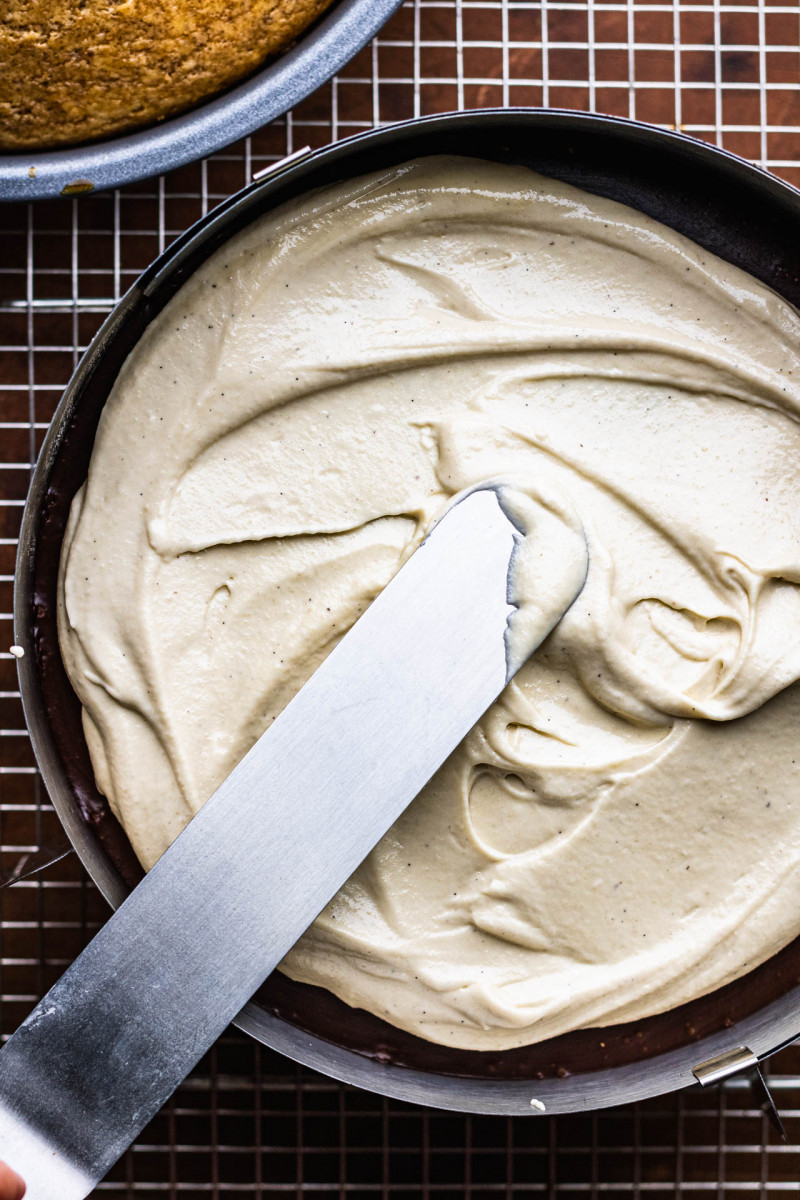
Apply about a third of the cream on top of the set ganache. Top with another layer of cake, cut the top of, soak with coffee mixture and pipe the rest of the cream on top.
CREAM LAYER
- 260 g / 2 cup cashews, soaked
- 100 g / 8 tbsp vegan butter (I use Naturli)
- 100 g / ½ cup caster (superfine white) sugar
- 90 ml / 1/3 cup + 2 tsp plant milk (I used soy)
- 15 ml / 1 tbsp vanilla extract
- cocoa powder, to decorate
CAKE LAYERS
- 30 ml / 2 tbsp lemon juice
- 360 ml / 2¼ cup plant milk (I used soy)
- 420 g / 3½ cup plain flour*
- ½ tsp salt
- 250 g / 1¼ cup caster (superfine white) sugar
- 1 tsp baking soda
- 1 tsp baking powder
- 15 ml / 1 tbsp vanilla extract
- 150 ml / 10 tbsp neutral oil (I use grapeseed)
COFFEE SOAK
- 2 tbsp instant coffee granules
- 2-3 tbsp Marsala wine (optional)
GANACHE LAYER
- 75 g / 2.65 oz 70% dark chocolate
- 60 ml / ¼ cup Oatly cream
- 1 tbsp instant coffee granules
- 12 g / 1 tbsp caster (superfine white) sugar
CREAM LAYER (make a day ahead)
- Soak cashews in cold water for several hours or in boiling water for 30 minutes.
- Once ready to blend the cream, place vegan butter, sugar and plant milk in a small pot. Set on low heat until the butter melts.
- Put drained cashews and vanilla extract in a large blender. Add sugar, milk and butter mixture and blend until completely smooth.
- Transfer to a container and refrigerate overnight to firm up.
CAKE LAYERS
- Combine lemon juice and plant milk in a jug. Let it sit for 5 minutes.
- Sift flour into a large mixing bowl, add both baking agents and salt. Mix well.
- Combine plant milk and lemon juice mixture with sugar, vanilla and oil. Mix well.
- Slowly add wet ingredients into the dry while folding them gently, a flexible spatula works best. Be careful not to overmix, fold slowly and gently only until there are no dry pockets of flour left.
- Preheat the oven to 160° C / 320° F (or 140° C / 280° F with a fan) and grab two 20 cm / 8″ cake pans. Line the bottoms with baking paper, especially if the pans aren’t non stick. You may also want to use baking strips, see explanation under the recipe.
- Divide the batter between two cake pans evenly. Bake in a pre-heated oven until a toothpick inserted in the middle comes out clean – about 30 minutes (longer if using baking strips).
- Cool the cakes completely, then shave the top off with a serrated knife so that the cake is able to soak the liquid up better.
COFFEE SOAK
- It is best to soak the cakes separately as once soaked they are fragile and so difficult to stack – dissolve 2 of instant coffee in 160 ml / 2/3 cup of hot water and add a couple of tablespoons of Marsala wine if using.
- Place the bottom cake layer in a tall 20 cm / 8″ tin first (I used an adjustable cake ring) so that when we top it with ganache, the ganache has something to set against. Line the sides of the tin for easy removal if necessary.
- Using a pastry brush apply half of the coffee soak to the cake, in multiple passes, until the cake absorbs all of the coffee soak.
GANACHE
- Combine broken up chocolate and Oatly cream in a metal or glass bowl suspended over a pot of water, but make sure the bottom of the bowl does not touch the water.
- Set on low heat and allow the chocolate to melt slowly into the cream – do not stir yet. Once the chocolate has melted, switch off the heat and stir the two together gently. Then slowly in add instant coffee dissolved in 60 ml / ¼ cup of hot water. Stir gently together. Allow the ganache to cool down, but you still want to be able to pour it.
ASSEMBLY
- Pour the ganache over the soaked base cake layer (be sure the cake is in a tall tin so that the ganache does not flow don’t the sides!!). Allow the ganache to set completely on top of the bottom cake.
- Take a third of the cream mixture (approx. 200 g / 7 oz) and spread it on top of the set ganache. Pop the rest of the cream into the freezer for easier piping.
- Place second cake layer very gently on top. Next, soak the second cake with the rest of the soak liquid.
- Finally, pipe the rest of the cream on top of the cake and refrigerate overnight. Dust lightly with cocoa powder just before serving.
*BAKING STRIPS: Baking strips (combined with lower oven temperature) are often used when making layered cakes as they minimise doming. You can buy baking strips or you can improvise, which is what I did when baking the bottom layer. I cut an old tea towel into half lengthwise, soaked it in water, wrung the water out completely, folded into a strip as tall as my cake tin, wrapped it well in a piece of kitchen foil to make it oven-proof and wrapped it around the cake tin (I needed 1 and a bit of strips). The cake did not come out flat but it came out less domed than it usually does. It’s certainly something I will be experimenting with further next time I make a layer cake. One thing to note is that if you are using a baking strip, the cake will likely need a bit longer in the oven. Mine needed 10 minutes longer.
*GLUTEN-FREE: I have not tried making this particular cake without gluten but in my experience, if you use a good blend of gluten-free flours and 3½ tsp of xanthan gum (½ tsp per 1 cup of flour) it will work perfectly.